Peptide Protocol Library
Reconstitution. Dosing. Storage. Done right — an independent, evidence-referenced reference for research-grade peptides.
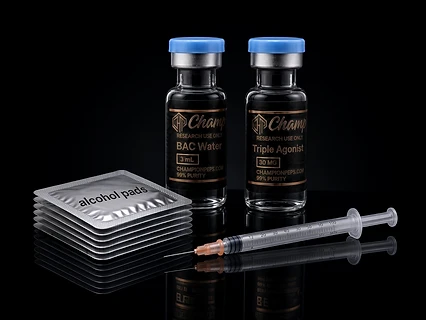
BAC water · 30mg Triple Agonist vial · alcohol pads · U-100 syringe
Create your own protocol
Enter your vial strength, bacteriostatic water volume, and target dose to get exact concentration, draw volume, and syringe units — live, as you type.
- ✓Live concentration & draw volume
- ✓Visual U-100 syringe fill
- ✓Total doses per vial
Reconstitution Calculator
Vial strength → BAC water → target dose
Common vial sizes
Label claim
Total doses in vial: —
U-100 syringe: 100 units = 1 mL
Where research peptides come from matters
Every dose chart on this site assumes the vial actually contains what the label says. That is not a given: research-grade peptides are not held to pharmaceutical standards, and published trial data never automatically transfer to an uncharacterised vial. Before the maths matter, four things do.
Certificate of Analysis
A per-batch COA stating identity and purity — not a generic PDF reused across products.
Independent testing
Third-party laboratory results, not in-house claims. HPLC and mass spec are the usual methods.
Cold chain
Lyophilised peptide degrades with heat and light. Storage and shipping conditions decide what arrives.
Batch consistency
The same product should test the same twice. Reconstitution maths only hold if the fill does.


Champion Peps & NoCo Research
The suppliers we reference across these protocols. Per-batch Certificate of Analysis and third-party testing published for every product. Research use only — nothing sold there is approved for human use, and listing a supplier is not an endorsement of any protocol on this site.
Latest Articles
Stay informed with new methods and data for peptide research.
Semaglutide and Panic Attacks: Active-Comparator Disproportionality Analysis, Temporal Assessment of Notoriety Bias and Evidence Triangulation in Post-Marketing Pharmacovigilance
Melamed B et al. · Pharmacoepidemiology and drug safety · 2026 Nov
Read MorePancreatic δ cells are resistant to auto- and paracrine inhibition in human type-2 diabetes
Omar-Hmeadi M et al. · Proceedings of the National Academy of Sciences of the United States of America · 2026 Nov 3
Read MoreInterpreting Diabetic Retinal Outcomes After GLP-1 Receptor Agonist and Tirzepatide Initiation: Clinical Evidence and Its Limits
Wu B et al. · Diabetes, obesity & metabolism · 2026 Oct 27
Read MoreGLP-1-Based Therapy in Type 1 Diabetes: Balancing Efficacy, Safety, and Patient Selection
Rossatto T et al. · Diabetes, obesity & metabolism · 2026 Oct 27
Read MoreResearch use only
Nothing on this site is medical advice or approved for human consumption. Protocols reference peer-reviewed data where available and are published for laboratory research documentation.