Prep & Injection Guide
A clear, step-by-step reference for storing, reconstituting, and administering peptides — built for easy reading and clean separation between every step.

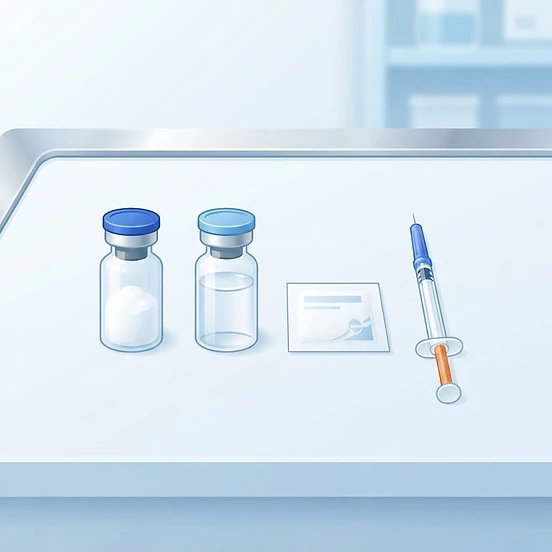
Peptide Storage
Peptides are fragile. Stable conditions protect potency and shelf life — and when you hold several vials, only reconstitute the one you'll dose from.

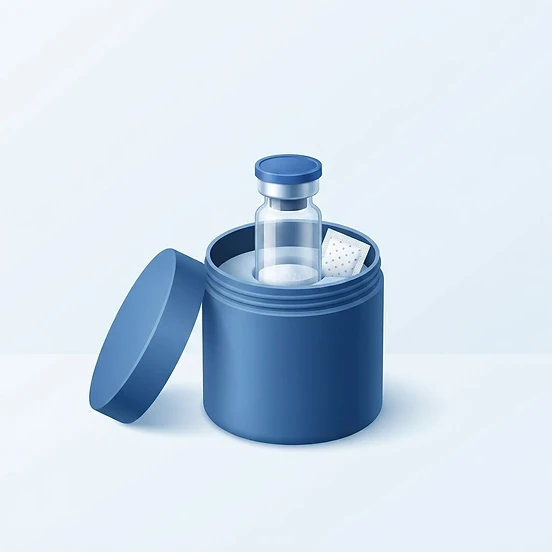
Factors that reduce stability
Temperature swings
Warmth accelerates degradation — keep conditions stable.
Freeze / thaw cycles
Repeated cycling is one of the fastest ways to lose potency.
Humidity
Moisture invites degradation and crystal formation.
Light exposure
Prolonged light steadily erodes potency.
Mechanical shock
Dropping a vial can damage the peptide inside.
How to prepare for storage
- 01
Choose a light-blocking container
Use one that seals tightly. If it isn't opaque, wrap the vials in foil.
- 02
Add desiccant packets
Silica gel keeps moisture down — a small investment with real payoff.
- 03
Seal and store by schedule
Refrigerate or freeze depending on how long you plan to keep it.
Storage duration
| State | Storage | Duration |
|---|---|---|
| Reconstituted | Fridge · 36–46°F (2–8°C) | 60–90 days |
| NAD+, AOD-9604 | Fridge · 36–46°F (2–8°C) | 30–45 days |
| Lyophilized | Room temp · 68–77°F (20–25°C) | 30–60 days |
| Lyophilized | Fridge · 36–46°F (2–8°C) | Up to 1 year |
| Lyophilized | Freezer · -4°F (-20°C) | 2–3 years |
Lipo-C exception: do not refrigerate — it will gel. Store at 68–77°F (20–25°C), away from light.
Supplies Needed
Gather your materials before you start so the process stays clean and uninterrupted.
Required
- Alcohol prep padsFor sanitizing vial tops and injection sites.
- Bacteriostatic (BAC) waterOr the specific solvent your peptide calls for.
- Clean insulin syringes0.3 mL for single-unit doses; 1 mL for larger.
Optional
- 22–23 G, 3 mL syringeFor accurate reconstitution volume.
- Storage containerLight-blocking and moisture-proof for the fridge.
Syringes & Measurement
Knowing your syringe makes dosing accurate. Each type has a tick value and a best use.
1 mL · 100u
Doses over 10 units
Each tick = 2 units
Can't read single units precisely
0.3 mL · 30u
Single-unit doses (2, 5, 7u)
Each tick = 1 unit
Best precision available
3 mL · 22–23 G
Measuring BAC water
Short lines = 0.1 mL
For reconstitution
Luer Lock 10 mL
Large volumes / Lemon Bottle
Needle sold separately
Luer-lock fit
Needle gauge
Higher number = thinner needle. Reconstitution typically uses 27 G; dosing 29–31 G.
Needle length
Subcutaneous: 5⁄16″–½″ (8–12 mm). Intramuscular: ½″ (12 mm) recommended.
Reconstitution
Mixing the vial is gentle and deliberate — never shake. Roll, rest, and let it dissolve.


- 01
Remove the caps and clean
Wipe the top of both the peptide vial and the BAC-water vial with an alcohol prep pad.
- 02
Select your syringe
A 22–23 G, 3 mL syringe is ideal for drawing water. A 28–29 G insulin syringe also works.
- 03
Draw the bacteriostatic water
Insert the needle into the BAC-water vial, invert it, and pull the indicated volume.
- 04
Add the water to the peptide
Insert the needle into the peptide vial and press the plunger slowly and gently against the glass wall.
- 05
Remove and dispose
Cap the syringe and dispose of it properly in a sharps container.
- 06
Mix gently
Roll the vial between your palms — don't shake. Let it rest 15–30 minutes to fully dissolve.
Tip: before each dose, roll the vial gently between your palms to keep the solution even.
Subcutaneous Injection
Injected into the fat layer just beneath the skin — the most common research route.
- 01
Clean the vial and draw the dose
Swab the vial top with alcohol. Invert and draw the indicated amount.
- 02
Prepare the site
Clean the injection site with a fresh alcohol pad and let it air-dry.
- 03
Pinch and insert
Pinch a fold of skin and lift it away from the muscle. Insert the needle fully with a quick, smooth motion.
- 04
Depress the plunger
Inject the full dose. Hold for a few seconds before withdrawing.
- 05
Post-injection
Gently rub the site for about a minute. Return the peptide vial to the fridge.

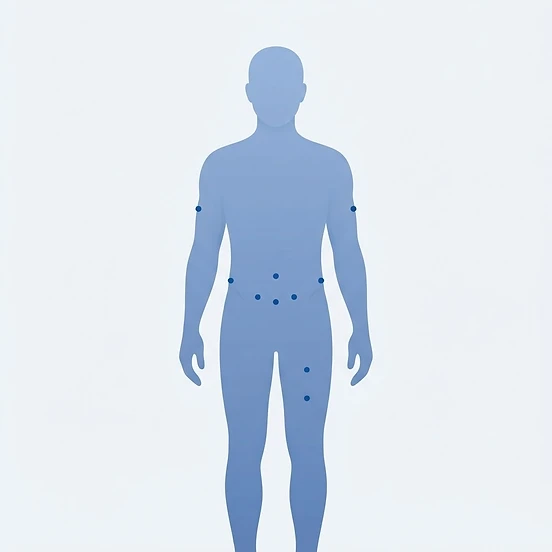
Best injection sites
Intramuscular Injection
Delivered directly into the muscle belly for faster uptake in some protocols.

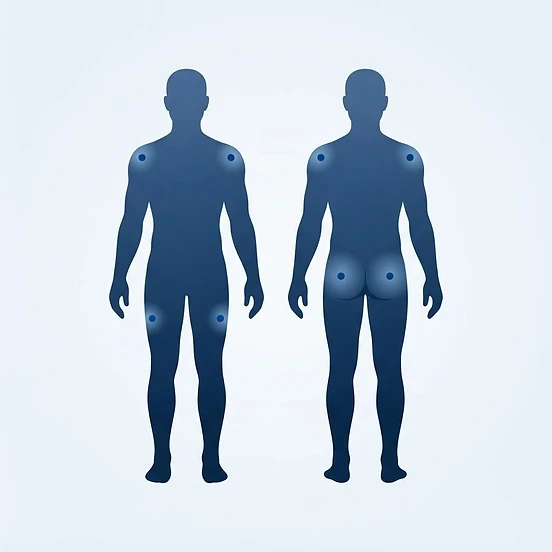
Best injection sites
- 01
Clean and draw
Swab the vial top. Draw the indicated dose from the inverted vial.
- 02
Prepare the site
Clean the injection site with an alcohol pad and let it air-dry.
- 03
Inject into the muscle
Push the needle quickly through the skin and into the muscle belly.
- 04
Complete the injection
Depress the plunger fully. Wait a few seconds before removing.
- 05
Post-injection
Rub the site briefly. Return the peptide vial to the fridge.
Ready to run the numbers?
Use the reconstitution calculator to get exact draw volumes for any vial and dose.
Research use only. This reference documents reconstitution and handling arithmetic compiled from published sources — not a clinical recommendation or approval for human consumption.